Machine Learning-based Real-time Visual Comfort Monitoring on Indoor Lighting in CCRCs
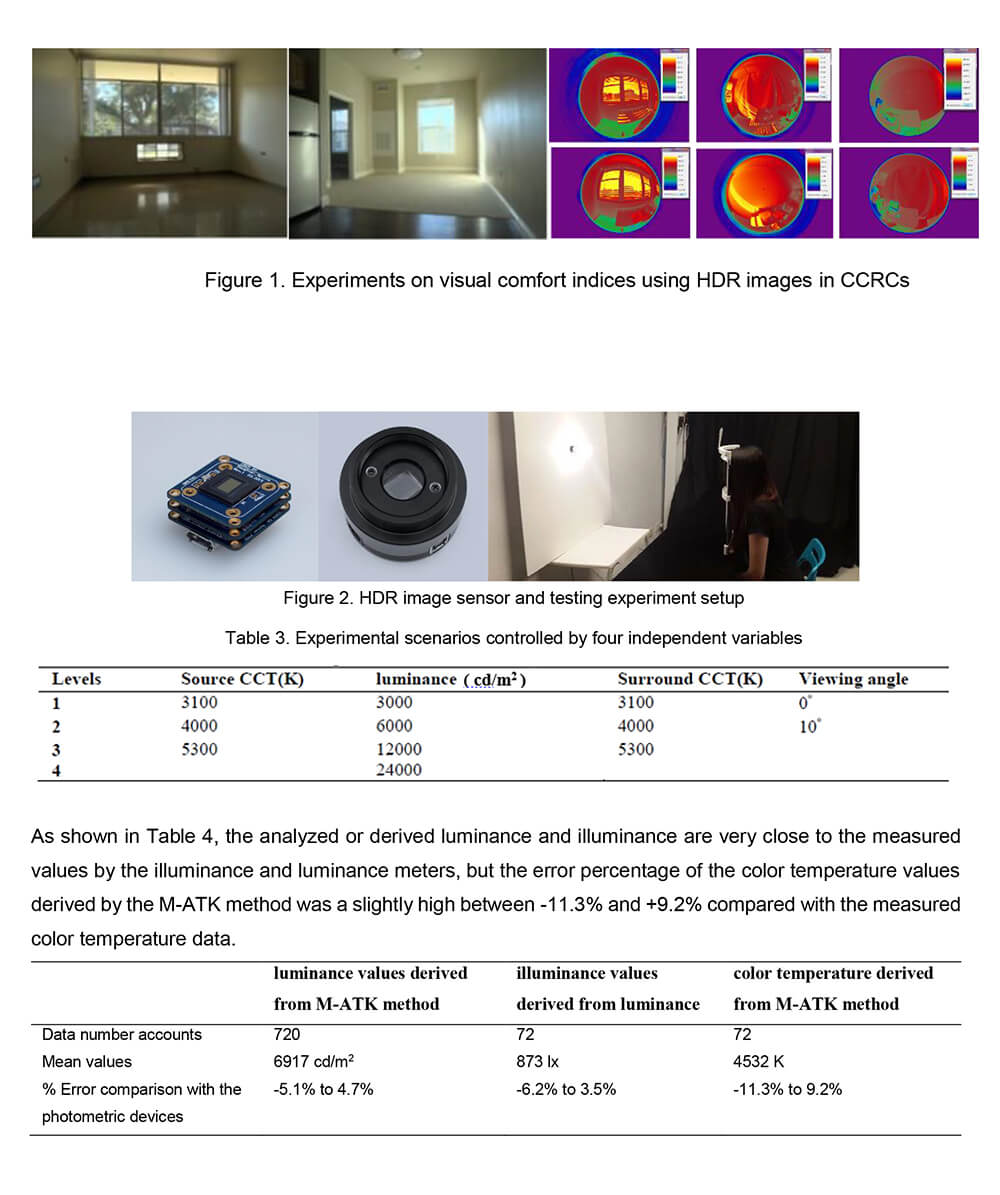
A report from the 2014 U.S. Census Bureau indicates that at that time, there were approximately 4,800 continuing care retirement communities (CCRCs) with over 640,000 residents in the U.S. Many studies have reported that poor indoor lighting quality is related to increases in eyestrain, headache, fatigue, anxiety, depression, etc. Because up to 90% of a typical senior’s time is spent indoors in a retirement community, monitoring residents’ actual lighting quality are of special importance to senior healthcare. Our survey on regional CCRC healthcare teams in Ohio, Kentucky, and Indiana revealed that 47 of total 52 CCRCs perform periodical on-site visits on indoor lighting conditions using surveys, interviews, and certain photometric measurements. However, these methods are normally non-real-time, non-continuous, bulky, costly, and passive. Comparatively, the development of real-time visual comfort and lighting quality monitoring is so far behind the development of other indoor environmental quality (i.e. air quality, temperature, noise) monitoring that has been real-time, interactive, and widely used in healthcare facilities for long time. The key hurdle to develop such technology design for indoor lighting is the complexity of visual comfort measurements and the variety of user lighting needs of different activities. Traditionally, the use of physical prototypes, scale models, advanced computational simulation, as well as in-situ photometric measurements has been a source of valuable, real-world information about lighting quality and visual comfort. However, such an approach relying on high-level computation, complex measurements, and/or camera-based HDR images cannot be used for the real-time monitoring objective. This work explores an alternative approach that uses machine learning algorithms and physical-based photometric measurements by wearable sensors to achieve approximation of visual comfort indicators, which will meet the aforementioned needs.
The grant furthered Julian Wang’s academic research, on-campus teaching, and outreach activities in lighting along with the purchase of materials and supplies needed to set up new pilot lighting projects in his courses.